
Tell me if this sounds familiar.. It’s 4:30pm on Friday and the phone starts ringing.. We all know what happens, any techs or drivers in the building suddenly disappear as if they can escape the imminent short straw draw on who will have to go check the gas line that your customer’s landscaper just hit. Once the politics play out and someone is dispatched to investigate, you find out that they had to repair a line that was only 4-inches deep.
Everyone is aware that per NFPA 6.11.3.13, buried metallic pipe and tubing shall be installed underground with a MINUMUM of 12” of cover. We also know that not all companies/installers follow the rules and operate with Safety as their number one priority. Sometimes they cut corners and sometimes they are pushed to get more done than they can Safely do in one day. I used to have a camper, before I bought it, I did a lot of research. I found that every resource I found told me to check serial numbers and find out if it was manufactured on a Monday or a Friday and to stay away from those because they tended to have more issues. I’d say the same may be true about the service industry. Monday is the first day back after the weekend’s activities and there is always an extra job or two that has to be done because of a weekend call and on Friday, everyone wants to get their weekend kicked off, so things may get a little rushed.
Regardless of the reasons, we need to all be reminded that we work with what can be a dangerous gas and we must operate Safely at all times. I implore you to, first off, operate within the requirements of your Authority Having Jurisdiction. If you are required to pull a permit, then pull one. If you aren’t required to have one, that does not relieve you of your responsibility to complete your install to code. Bury your gas line to the proper depth, bury it deeper if external forces are likely to cause damage, protect it if you cannot reach the proper depth by running it through conduit. If you are running plastic line, be sure to follow NFPA58 6.11.4.6 and bury a minimum AWG14 wire or tape with your gas line making sure that is not in direct contact with the gas line. Remind your installers and yourself that a little (sometimes a lot) extra work up front will save lots of extra work on the backside and may prevent an unnecessary and avoidable accident.
PRODUCT SPOTLIGHT
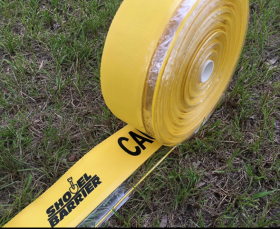
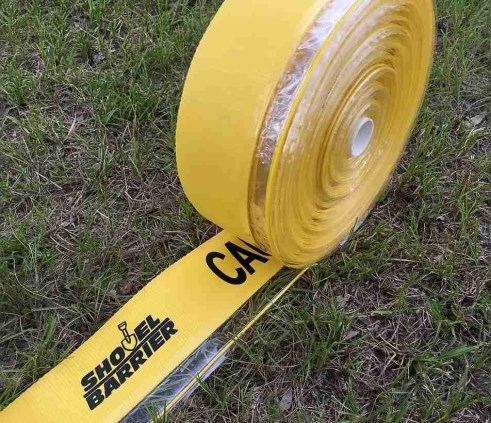
If you came to the Gardner Marsh Open House back in May, then you may have seen a full grown adult playing in what looked like a sand box. Depending on your perspective, it may have also looked like a crazed murderer trying to dismember their victim! Either way, it was JUST the Shovel Barrier demonstration box. When using Shovel Barrier , it takes a force of 3960 lbs to break through the barrier. Shovel Barrier provides the most complete form of protection for ug poly line. It features 3-in-1 functionality; protection, warning, and traceability. The barrier’s synthetic properties make for long lasting protection against excavation. It also adds the needed time for recognition of the gas line that is being hit before causing a leak. It is available in 325’ rolls that are highly portable and meet APWA Color Code specification. Through 11/30/2023, you can get the 325’ roll for just $250! I highly recommend trying this product out, if it saves you one after-hours call, then it has paid for itself! Consider using it strategically - for example, if a line is ran a few feet through a garden bed, that would be a good place to install Shovel Barrier.