
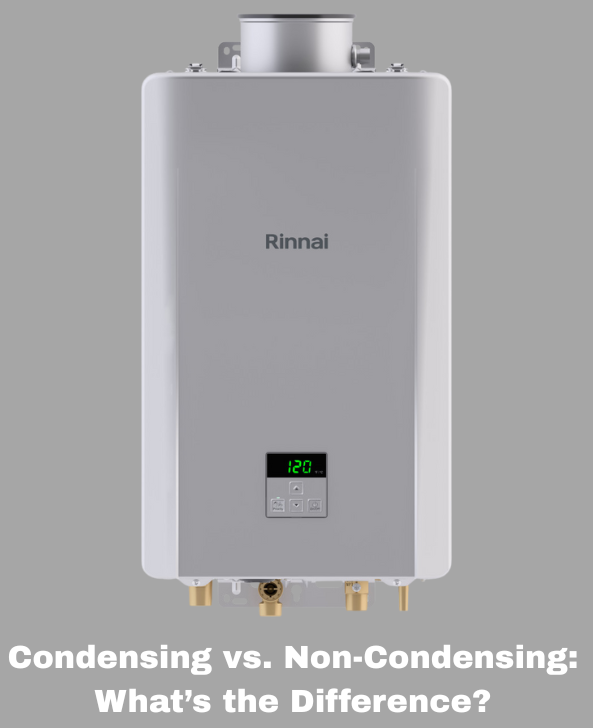
 We sell a lot of Rinnai tankless water heaters, I am talking pallets of these everyday! When customers call in though, they sometimes aren’t sure which model they are looking for. One of the questions we typically ask is, “Do you want a non-condensing or condensing model?” The most common response is, “What’s the difference?”
Let’s explore the answer to this question. Everyone is different, but if you ask me what the difference is, I am going to start with efficiency. If your customer wants to be green, then I push towards condensing. If your customer doesn’t care, then I am going to ask you where the heater will be located and how much venting you will need to install. If you tell me it is in the middle of the house and you need to run a bunch of venting, and you are able to find a place to drain the condensation, I will again push towards condensing.. If the unit is outside or you only have a short venting run, then I’ll tell you to go non-condensing. Let’s get into the Why’s of the above answers!
While all propane tankless water heaters ARE efficient, condensing units are much more efficient with the newest RX line from Rinnai being up to 98% efficient on Natural Gas and 97% efficient on propane! What does that even mean you ask? I’m glad you did! It means that for a propane unit, $0.97 out of every dollar spent on propane is used to heat the water, only losing $0.03 to exhaust gases. For a non-condensing model, you can reach 81% efficiency, losing $0.19 to exhaust. In comparison, a tanked propane water heater will lose $0.40 of every dollar to exhaust. As you can see, condensing units are super-efficient.
Have you ever put your hand at the vent termination of a tankless water heater? If you do this on a non-condensing unit, you will need to pull your hand away quickly to avoid being scalded as the exhaust is pushing 300°F! This is why concentric metal exhaust must be used. If you use PVC/CPVC/Poly to vent this, it will melt and you will have all kinds of issues. Do the same on a condensing unit and you can hold your hand there much longer as this exhaust is only about 100-150°F. This is due to the condensing unit having a second heat exchanger built-in that uses combustion exhaust from the first heat exchanger to pre-heat the incoming water resulting in a much higher efficiency and lower exhaust temperatures. This allows for the use of different (often much cheaper) materials. This is why I ask where the heater is located and how much venting you will need to do. If you can vent a water heater with 2” PVC, you will more than pay for the additional cost of the unit over running the Ubbink concentric metal venting, which adds up very quickly.
One caveat of putting in a condensing unit is that it creates condensation during the process and this condensate needs to be drained somewhere. So depending on where you install this, you may also need to run a condensate line out. Sometimes this involves putting in a pump if you can’t rely on gravity to drain it. You can discharge condensate numerous ways, but be sure to comply with local code and building requirements. Some AHJs may require installation of a neutralization system (condensate is very acidic) and building code will have some requirements as well, such as maintaining a proper air gap to prevent the condensate being siphoned back into the unit.
This is a short summary of the differences between condensing and non-condensing unit. As with any sales consultation, make sure to involve your customer and allow them to make an informed decision on what they believe will work best for them. I hope you have found this info useful and as always stay safe and don’t ever hesitate to reach out with any questions you may have!
Product Spotlight
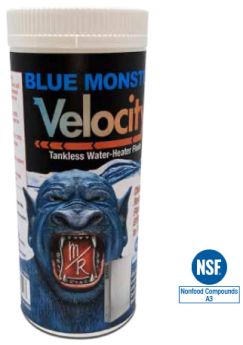
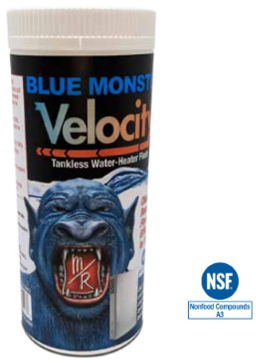 Many of you have heard of Blue Monster by The Mill-Rose Company. We are now carrying many of these products. Did you know they also make a tankless water heater flush? So in addition to our popular Flow-Aid and Calci-Free flush products, we are now offering the Blue Monster Velocity tankless flush. Blue Monster® Velocity™ is a hard-hitting, fast-acting compound with the strength needed to remove scale, lime, rust, and other corrosive water-formed deposits inside on-demand water heaters. Velocity contains sulfamic acid, a highly-effective agent used to clean heat exchangers, boilers and condensers. Restore water flow and heating efficiency for like-new performance with Velocity. Part number for ordering is 76052.
Blue Monster Velocity is approved for use on copper and stainless steel heat exchangers. It's non-corrosive and safe for potable water systems. Blue Monster Velocity is also NSF Nonfood Compounds A3 listed.
Email Darren! Dmcardle@gardnermarsh.com