
 There’s more than one way to skin a cat! While preparing for this month’s newsletter, I did far too much research on the origin of this cliche...you see, I was thinking of all the options you have to choose from as a gas line installer and that phrase came to mind. Followed by the thought: where the heck did that saying come from? It turns out, no one seems to really know anything about it’s origins other than that it is centuries old and there are a lot of old cliches that deal with harming our little animal friends. There is evidence from 1832 that there was a debate on whether or not skinning a cat should be done while they are still alive or not, so that could be the beginning of this unusual adage.
Now that I have gone way off-topic, and satisfied your new curiosity, let’s reel this back in. When you do a job, you may choose a certain material, while the next person may choose something totally different. The most important piece of any job is that you end up with the same result; a professionally installed, safe, functioning, and up-to-code gas system. When piping inside of a home or building, many factors must be considered, such as btu load, total length, fitting requirements, and obstacles.
My focus this month is the fittings aspect. There are specific requirements in both NFPA 58 and ICC codes when it comes to fittings in concealed locations.
Both codebooks have similar definitions, but I will use NFPA for this. It states in section 3.3.77.1 that concealed gas piping is, “Gas piping that, when in place in a finished building, would require removal of permanent construction to gain access to the piping.” If you break it all the way down this means: if you have to cut into something, then it is considered finished.
You are limited to the following fittings in these locations: (1) Threaded elbows, tees, couplings, caps, & plugs, (2) Brazed fittings, (3) Welded fittings, or (4) Fittings listed to CSA/ANSI LC 1/CSA 6.26, Fuel Gas Piping Systems Using Corrugated Stainless Steel Tubing, or CSA/ANSI LC 4/CSA 6.32, Press-Connect Metallic Fittings for Use in Fuel Gas Distribution Systems. A couple things to note here. The code does not mention Flared fittings, so if you choose to run copper, then it must be either a continuous run from penetration to penetration or you will need to cut access out and install a removable access panel wherever a fitting exists. Also, under item (1) , there is no mention of unions or bushings. Unions and bushings cannot be concealed under permanent construction. The wording from the code above is from the latest 2024 edition of NFPA 54, it specifically allows for the use of press fittings in concealed locations. One other note is this refers to permanent construction, so if access panels, doors, or other removable means to access fittings are installed, then it is no longer considered concealed. Also, drop ceilings with removable tiles are not considered permanent construction either. So even though there may be more ways to skin a cat, make sure that you are choosing one that will meet current codes and pass inspection! Be safe out there, my friends!
Product Spotlight
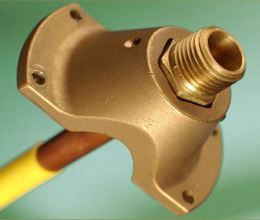
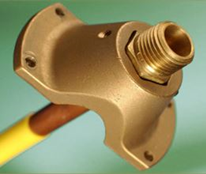 Since I started here, I occasionally run across products I never knew existed until I see them. That happened this past month while working on our website. I came across this great copper termination product. The Copper Stopper is a great product for appliance terminations or unfinished installs where you may normally coil up some copper. You simply install your flare nut to the copper, install your adapter fitting, and then slide the Copper Stopper over top, tighten the set screw, and install to the floor or wall for a nice clean copper termination.